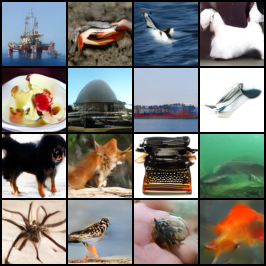
What is ArchiRF?
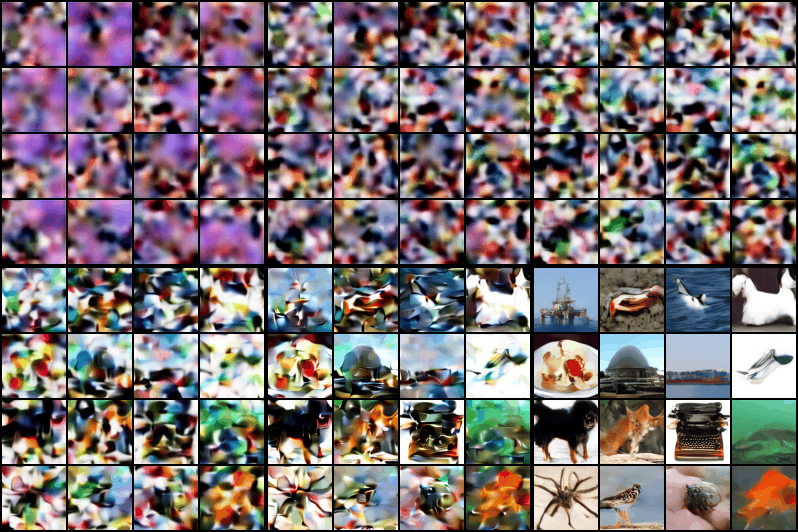
ArchiRF is a remarkable project that I have been working on for the past few months. It is a self-interested project aimed at creating a Rectified Flow model for my own experiments. These experiments can be meaningless, but I hope to learn something from them. Specifically, I want to learn how to implement a denoising diffusion probabilistic model(DDPM) and Rectified Flow which simplifies the process of diffusion and produces better results. Besides, I also implement several techniques introduced in some papers to improve the performance of the model. The whole project is trained using a single RTX 4090 GPU (sorry I am so broke😢).
Link to the project: ArchiRF🚀
Content
This is a part mentioning what I have done in this project. I may keep updating this part to record my process.
First stage
-
Code for DDPM and Rectified Flow
-
Code for different model architectures
- Diffusion Transformer
- Multi-modal Diffusion Transformer (MMDiT) from Stable Diffusion 3
- Unet from EDM2 paper
- Classic ADM Unet
-
Learning rate scheduler I have implemented these learning rate schedulers:
- Linear warmup scheduler According to the Stable Diffusion 3’s paper, the authors use a linear warmup scheduler to warm up the learning rate in the first 1000 iterations.
- Inverse square root scheduler Authors of EDM2 states that using an inverse square root scheduler can improve the performance of the model given the magnitude preserving techniques of the network.
-
ViT with Registers I have implemented registers for ViT which is introduces in the paper VISION TRANSFORMERS NEED REGISTERS.
MMDiT
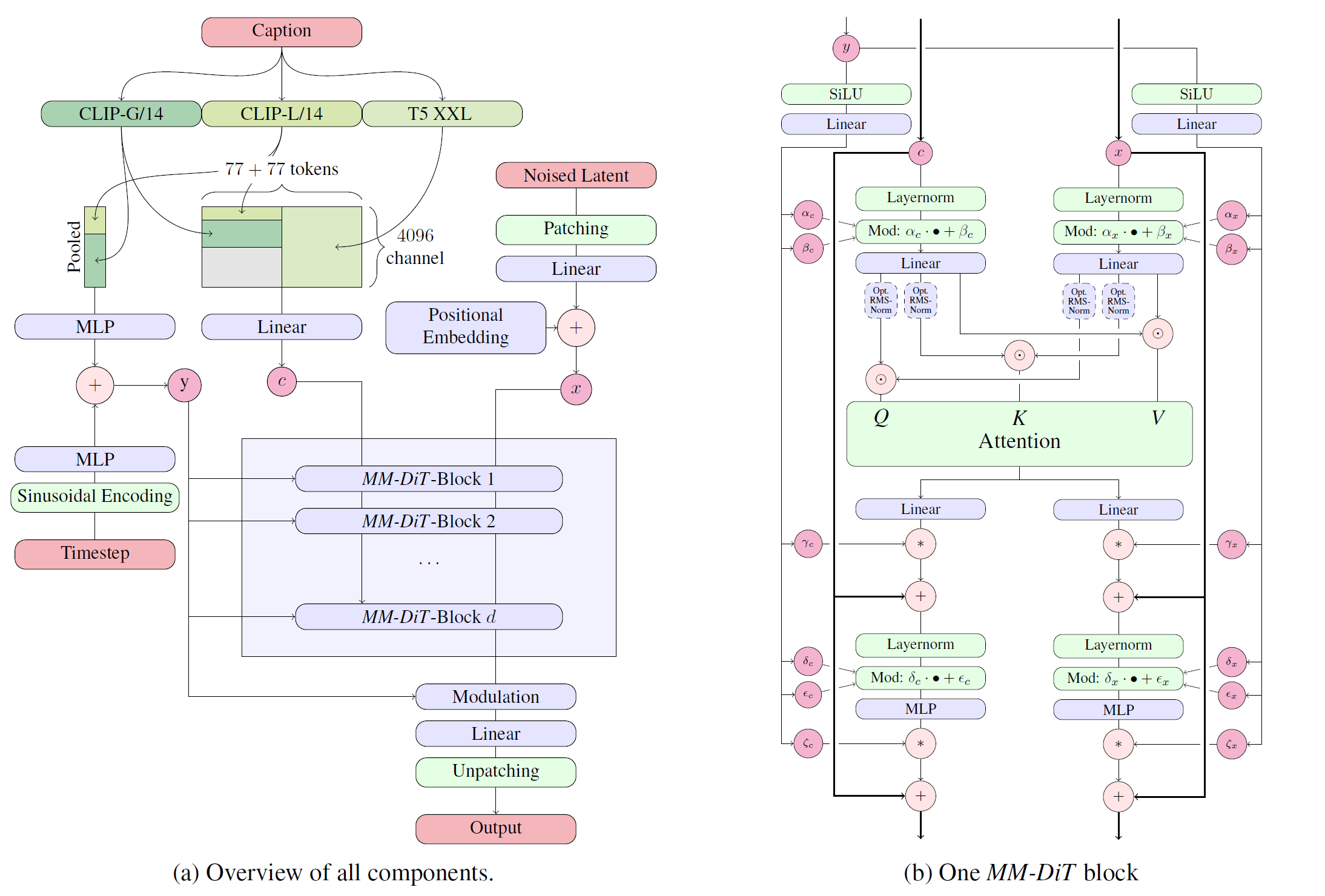
I have implemented the MMDiT network. Following the paper, I made several changes to both the rectified flow framework and diffusion transformer’s architecture:
- QK normalization
This can prevent explosion in the attention logits. - Logit-Normal Sampling for $t$
I use the logit-normal distribution to sample $t$ in the rectified flow model. This is said to be better then the uniform distribution.
However, with limited computational resources, I can’t train a text-to-image model. I use two class embeddings to simulate the text embeddings. However, I found out training the embeddings is very hard given a large number of classes in ImageNet. According to the StyleGAN-XL paper, it is possible to use pretrained class embeddings from a pretrained image classification model(Efficientnet-lite0 in their paper). They pool the image features at the last layer to act as class embeddings. I may try this method in the future.
My MMDiT model is a bit overfitted from looking at the FID, but at least it can generate some good images.
Second stage
At this stage, I will to level up this repo by implementing and training a latent diffusion model from scratch by myself. Due to limited computational resources, I will the Autoencoder model on ImageNet dataset with 64x64 resolution. After encoding the images with shape [B, 3, 64, 64], I can get a latent features with shape [B, 16, 8, 8]. This allows me to train a latent diffusion model with a single RTX 4090 GPU.
-
AutoencoderKL
Following the paper, I implemented the classic VAE model with KL divergence loss. -
Custom Autoencoder for latent diffusion
Based on the problem of the classic VAE model, I implemented a custom autoencoder which imo is more suitable for latent diffusion model. The custom autoencoder will be explained in the next part. -
Larger Latent Channels
According to SD3 paper, the larger output latent channels can produce better image quality.
What’s wrong with VAE?
There are already a few discussions about the issues of VAE in Stable Diffusion. FYR, you can check the links below:
- https://news.ycombinator.com/item?id=39215242
- https://news.ycombinator.com/item?id=39215949
- https://www.reddit.com/r/StableDiffusion/comments/1agd5pz/a_recent_post_went_viral_claiming_that_the_vae_is/?sort=new
I can summarize the problems of VAE as follows:
- The output latent of the encoder is not bounded to [-1, 1] with variance 0. This can introduce more difficulties in the diffusion process because we denoise the latent from a noise from a normal distribution. The scaling factor in VAE of SD cannot guarantee the latent to be in the range [-1, 1].
- KL regularization is not enough to prevent the encoder from limiting the latent space.
- VAE is not the only option for latent diffusion. VQVAE is also been tested in the original paper. But why don’t we try a vanilla autoencoder? Given the fact that people found out the variance term in VAE is not necessary to get a good quality of output image. (See the third link above)
Custom Autoencoder
Grouping the ideas from others, I implemented a custom autoencoder for latent diffusion. The custom autoencoder has the same architecture with my AutoencoderKL model, but having a few modifications:
- the encoded latent is clipped to [-1, 1]
- variance term is not needed because we don’t need to sample from a normal distribution
- the autoencoder is trained with the same loss functions introduced with original one in stable diffusion. However, instead of using KL divergence, I use a simple variance loss term to guide the latent space to have a standard deviation of 1.
- A gain parameter is added to the autoencoder to scale the latent space. It is reasonable that the encoded latent is not always having a normal distribution. Besides, simply clipping the latents may produce feature loss. The gain parameter can help to scale for better results.
Findings on the custom autoencoder
- Without the scaling term, the autoencoder is more diffusion to train. From my runs, the loss of the autoencoder is dropping slower without the scaling term.
- The variance loss term needs scaling. I found out that the variance loss term is too large to train the autoencoder. I scale the variance loss term by 0.01 to get a better result.
- As the training goes on, the autoencoder will have a better variance of the latent space while the scaling term keeps decreasing.
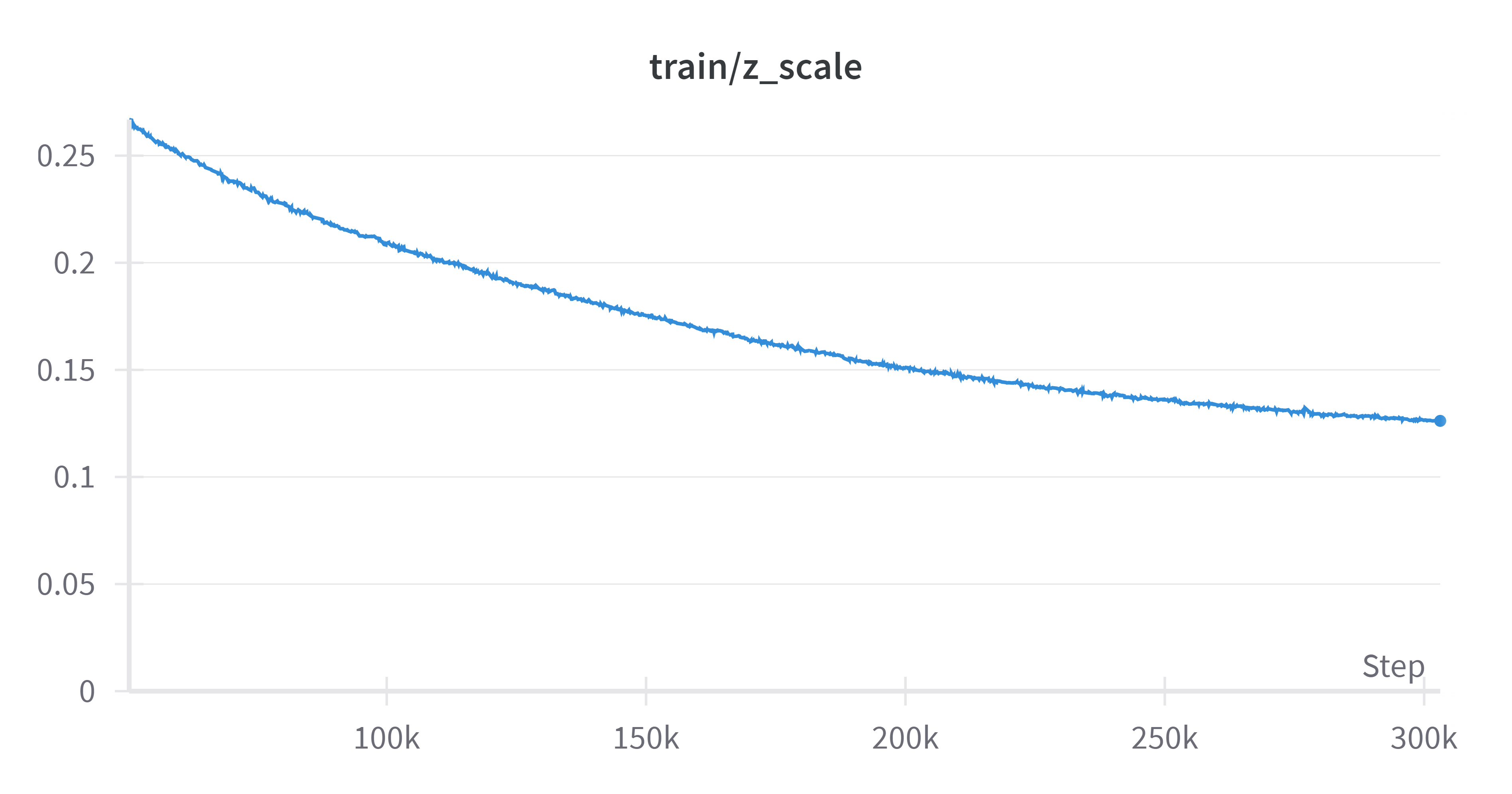
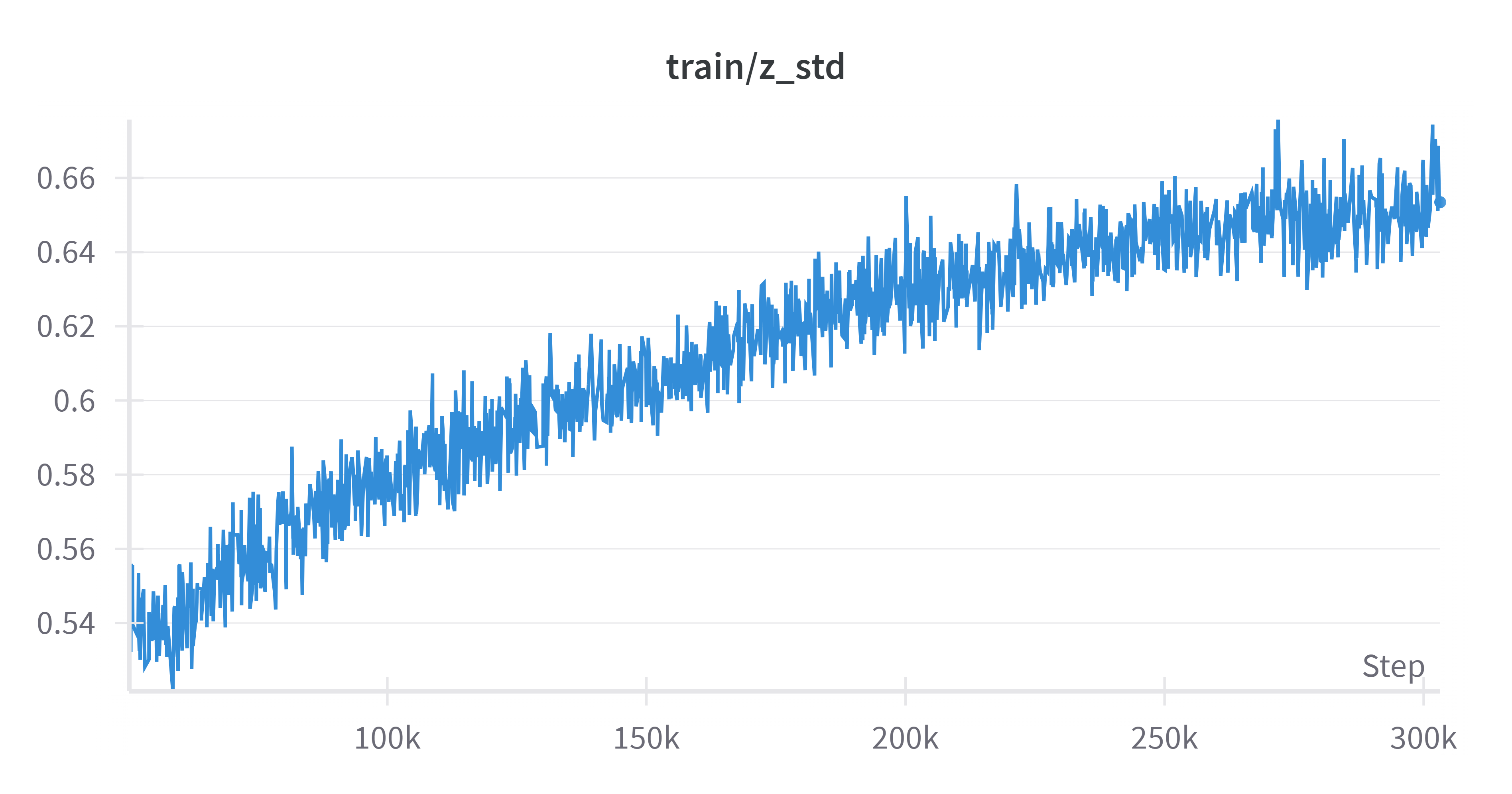
I may try to train the autoencoder with more modern GAN techniques like projected GAN or Squeeze-and-Excitation in the generator. But I think it is not necessary for now.
Latent Rectified Flow
After all, I can use the trained autoencoder to train a latent rectified model. I found that training a latent diffusion/rf model is way harder than training one on pixel space.
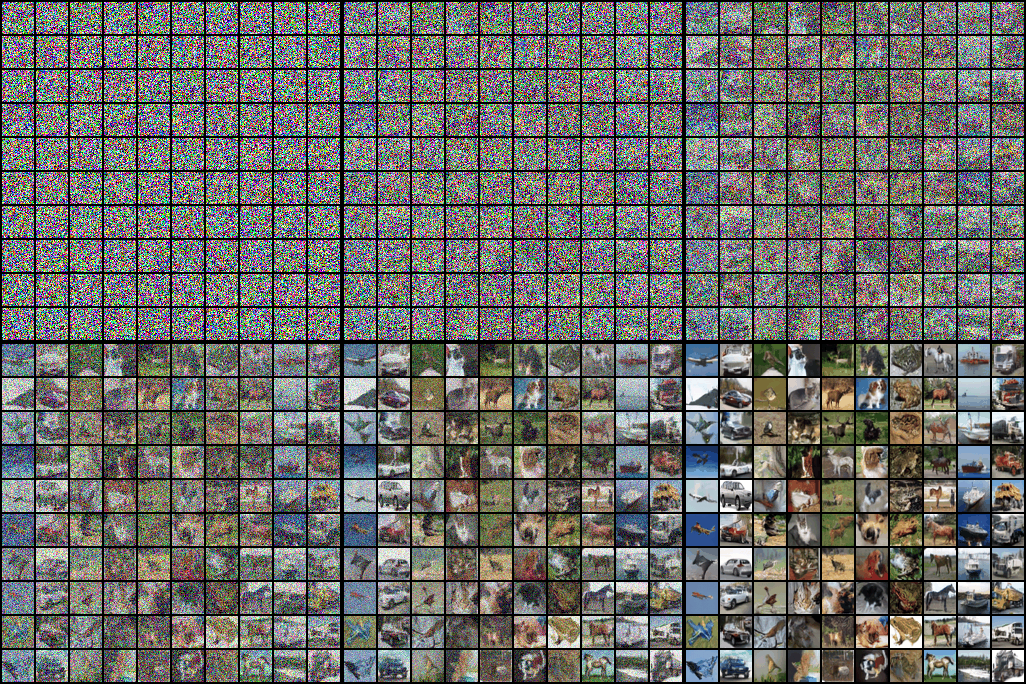
Samples of generating some classes in ImageNet with MMDiT and Latent RF: